Hearing as Survival
Bird BoxHearing as Survival is the practice of using sound in place of sight in a world where looking at the creatures can drive people to self-destruction. It gives Malorie and the children a way to move through the outdoors without lifting their blindfolds, but it cannot make the world safe or fully legible. A splash may signal fish or danger; an echo may mean another boat is following. Listening is both a learned survival skill and a source of suspense, because the family must act on what they hear without seeing what produced it.
A world reconstructed through sound
The question of how far a person can hear recurs as Malorie rows blindfolded down the river with the children. The boat repeatedly strikes the banks and becomes stuck, and while they wait, Malorie imagines unseen hands reaching from the water and mud to remove the children’s blindfolds. Against those frightening visions, the morning soundscape offers evidence of a living world: birds sing, fish splash, and animals move in the foliage. Malorie hears all of it, but sees none of it. The distinction is fundamental. Sound provides contact with the landscape while the blindfold protects them from the visual threat.
Malorie calls the river an amphitheater, a place where sounds arrive from the woods, wind, and dirt banks surrounding the boat. Yet she also understands it as a grave. The same open channel that carries information and offers a route forward exposes the family to danger. Her hope that a person can hear all the way to safety is therefore not a declaration that hearing guarantees survival; it is a hope tested against distance, uncertainty, and fatigue.
Training the children to listen
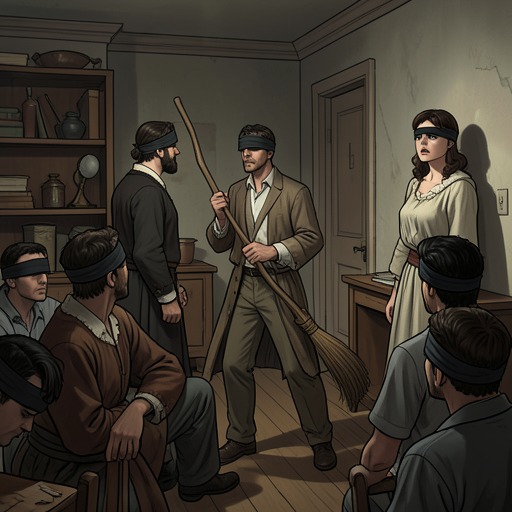
The children’s hearing is cultivated from infancy. Malorie tied T-shirts over their eyes and carried them to the edge of the woods, where she described sounds they were too young to understand: leaves crinkling and a small animal, perhaps a rabbit, though it might be something worse. As they grew old enough to learn, she trained herself alongside them. Her examples taught them to treat ordinary noises as evidence, but also to remain alert to the possibility that a sound might belong to a threat.
That education is imperfect and asymmetrical. Malorie was raised to rely on sight, and only at twenty-four could she distinguish a raindrop from a tap on a window using hearing alone. She questions whether this makes her the wrong teacher and whether exercises such as having the blindfolded children tell apart a leaf crushed by a foot from one crushed in a hand are adequate preparation. The children, she knows, may eventually hear better than she can. Their sensitivity is an advantage, but it also leaves Malorie dependent on them to interpret a world she cannot fully teach from her own experience.
Her lessons also give the children a limited vocabulary for things they cannot see. Malorie catches fish with a rusted fishing pole fashioned from an umbrella found in the cellar; the Boy likes watching them splash in a bucket and draws them afterward. Fish are among the few creatures the children can know through direct experience and representation. For other parts of the world, including cars, streets, gardens, and stars, they have only Malorie’s amateur drawings and descriptions. Listening helps them recognize a living environment, but it cannot supply the visual knowledge that their protected life withholds.
Sound as navigation and warning
On the river, sound becomes operational rather than merely descriptive. When the boat runs aground, the Boy stands and pushes it free against a moss-covered trunk, after which Malorie resumes paddling. The children do not scream or whine during these setbacks, and their patience helps the journey continue. Yet every splash can also trouble Malorie: because the Boy loves fish and remembers them, she fears his curiosity might lead him to remove his blindfold. A sound can invite attention toward the world and, at the same time, threaten the rule that keeps him safe.
Listening also helps the family assess other people. After passing a man in a boat, Malorie realizes that the children kept their blindfolds on and did not heed the first living human voice they had heard beyond one another’s. Their obedience confirms how thoroughly she has trained them, but the episode unsettles her: that discipline has been formed by fear. Hearing a voice does not require them to trust its speaker, and their refusal to respond protects them in the moment while revealing the cost of a childhood organized around danger.
At the safe house, the same reliance on sound shapes practical work. During a blindfolded trip to the well, Felix carries one of the housemates’ six buckets along a path marked by pieces of old picture frames. A rope tied around his waist leads back to a steel stake outside the rear door; its slack rubs against his leg as he walks. The frame pieces indicate when he veers too far to either side, while hearing supplies another kind of orientation. When an unfamiliar sound comes again for the third time, Felix can tell that it is coming from inside the well. Sound identifies a danger whose source remains unseen, and the well’s apparent usefulness as a water supply becomes uncertain.
That uncertainty carries into decisions about drinking. When Felix asks whether they can drink from the river, Tom says it depends on how cold and deep the water is and how fast it flows; Jules argues that if something has entered the well, it may have entered the river too. Their discussion shows that sound alone cannot settle questions of contamination or safety. Hearing can locate an event, but it does not necessarily explain what caused it or establish whether a resource is safe to use.
The limits and emotional cost of listening
The river’s soundscape can turn from guidance into overload. As the family approaches the end of the journey, the Girl says the birds above them are too loud for her to hear. Malorie stops rowing and asks the children what the birds sound like to them. The episode reverses the expectation that more acute listening always means better information: the sound is so prominent that it interferes with the child’s ability to distinguish what else may be present. An alarm or environmental cue can become noise that obscures other cues.
The children’s hearing is particularly consequential when the Boy detects what sounds like a second boat rowing in step with Malorie’s. Malorie asks him to describe the unseen follower, but he cannot identify who it is. The echo establishes a possible presence without revealing its purpose. Malorie wonders whether the sound belongs to someone escaping their own home or to someone who might harm the family; she also recognizes that the person could have attacked them while she was unconscious. Listening gives her enough information to become alert, not enough to know what action is safest.
The book repeatedly sets such uncertainties against the apparent security of rules and preparations. During the global crisis, television reports and government instructions tell people to lock their doors, cover their windows, and avoid looking outside; on the radio, music gives way to discussion. Later, when Malorie attempts a blind drive to find equipment, the Wagoneer strikes curbs twenty times, poles twice, and a parked car once. Though that journey is not an exercise in listening alone, it makes plain the broader cost of moving without sight: precautions and limited-speed plans cannot eliminate obstacles the driver cannot identify. Hearing as Survival is a necessary adaptation to that danger, not a replacement for visual certainty.
Narrative significance
The repeated question of how far a person can hear links the river journey to the book’s wider crisis of perception. Public reports first make the catastrophe known through screens and radio, but as the social world shuts down, hearing becomes an intimate, bodily means of orientation: the voice of a broadcaster, the sound inside a well, birds over the boat, and a possible second set of oars. The scale shifts from distant news to immediate, uncertain signals. Information remains available, but its source, meaning, and reliability must be judged in the dark.
Hearing also defines the difference between Malorie’s generation and the children’s. She teaches them to live without sight while recognizing that their capacity to listen may surpass hers; they are at once her pupils and the people on whom she depends. Their skill preserves the family’s ability to move, yet it is inseparable from the fear that has shaped their obedience and from the possibility that sound will mislead or overwhelm them. Listening does not reveal a safe world. It lets the family navigate a world they cannot look at, one sound at a time.